Cultural differences in a globally connected world
22.4.2026Vojtěch Hrbas
This article is not exactly technical, but even as tech people, we often find ourselves communicating with other people from different nationalities, sometimes with colleagues from multiple countries in a single meeting. I would like to motivate you to pay attention when you are talking to the next person coming from a different culture. You can discover that our culture shapes us in various ways, although most of us are probably not aware of it.
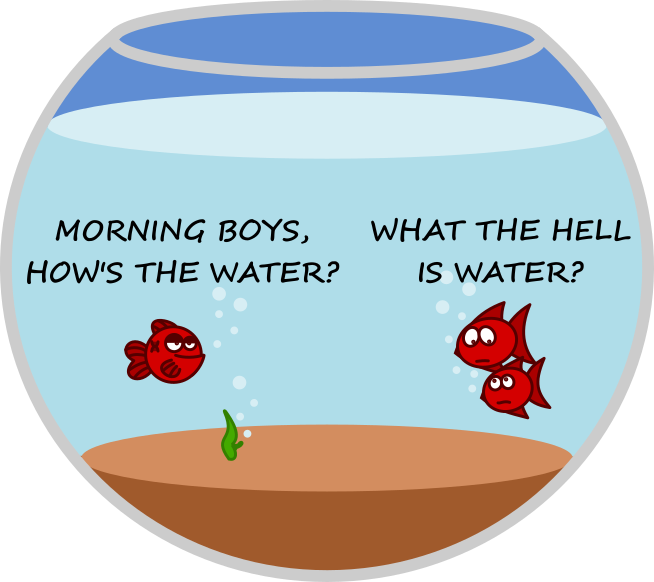
As shown in the title image, the young fish are asking, "What the hell is water?" They've spent all their lives in the same environment, so they don't know they live in water. It's similar to how we live in our culture. If you get more interested, I recommend you read the book The Culture Map by Erin Meyer.
She describes how we communicate with each other; she uses a culture map tool to clearly show how many countries stand next to each other. I will present a few ideas and pictures from the book to arouse your curiosity. You can discover much more in the book itself.
Personal stories
I picked a few stories from my professional career; maybe you can relate to some of them too. I will describe them bluntly and later I will try to figure out what might have happened. Please be aware that I don't want to claim that people from the mentioned coutries did something wrong. If you find yourself thinking of situations from my stories, try to find out if it could be your culture shaping your opinions. I should mention that I am Czech; it will be more important later but keep it in mind when you read about my encounters.
I worked in a British-owned company. We had our department organized in small teams, but we were missing a specialized role. Our management found someone in England since we couldn't hire anyone in time in Czechia. He told them he was an expert, but they didn't have a way to evaluate his claims. My Czech colleagues had some difficulties explaining that they wanted to interview him themselves before he was introduced as a new expert.
The following is more of an observation than a story. I think that we, Czechs, often sound very pessimistic. For example, we use the word "problem" to describe anything that is not going smoothly. I realized that, e.g., colleagues from the United States react to the same word differently, like something horrible is going on. Only much later did I discover that a problem in the United States is considered a serious incident, while a problem in Czechia can be basically anything from a spilled drink to a building on fire.
We cooperated with suppliers from India at the same company I mentioned earlier. They delivered a lot and I was to make a review of their work. I did the review just like I would for my Czech colleagues, so I pointed out everything I thought was worth discussing. I sent them my review; their manager wrote us an e-mail a few days later. He sounded angry, and he was refusing points from my review.
My last story is an encounter between Czech and French colleagues. A French colleague didn't want to use one of the tools we were using. Our Czech colleague told us about it, and she sounded concerned. She even mentioned that he was very expressive about it, and she was asking a different colleague from France if he could talk to him instead.
The Culture Map
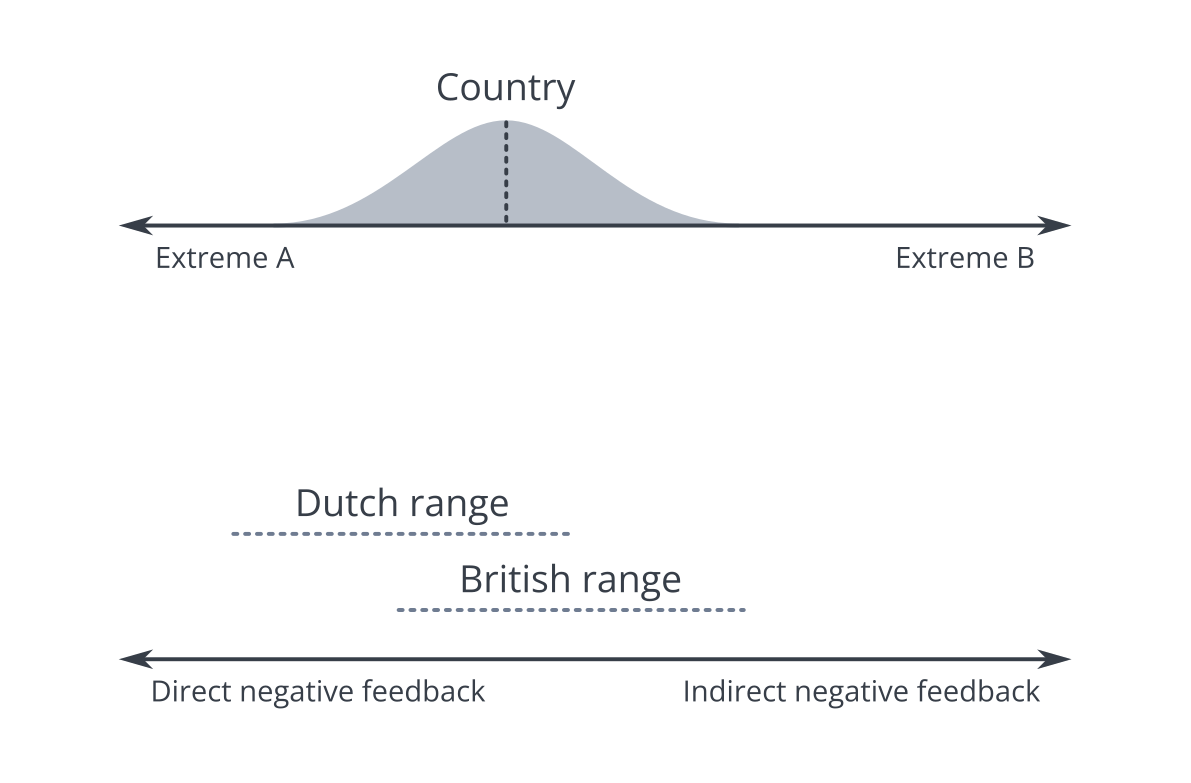
Here comes the book itself. Before we dive in, I would like to explain how the mapping tool is designed. For each country, there are points in the actual mapping tool placed on several axes. But that is only to keep things clear; you can imagine that it's the middle of a Gaussian distribution for a given country. You can see it visualized in the image below; it comes from the book
The example with giving negative feedback shows that roughly half of Dutch and British people might understand each other. But the other halves will have difficulties communicating clearly. Another example coming from the book shows this in a theoretical conversation.
What the British say
What the British mean
What the Dutch understand
With all due respect...
I think you are wrong.
He is listening to me.
Perhaps you would think about... I would suggest...
This is an order. Do it or be prepared to justify yourself.
Think about this idea and do it if you like.
Oh, by the way...
The following criticism is the purpose of this discussion.
This is not very important.
I was a bit disappointed that...
I am very upset and angry that...
It doesn't really matter.
Very interesting...
I don't like it.
He is impressed.
Could you consider some other options?
Your idea is not a good one.
He has not yet decided.
Please think about that some more.
It's a bad idea. Don't do it.
It's a good idea. Keep developing it.
I'm sure it's my fault.
It's not my fault.
It's his fault.
That is an original point of view.
Your idea is stupid.
He likes my idea!
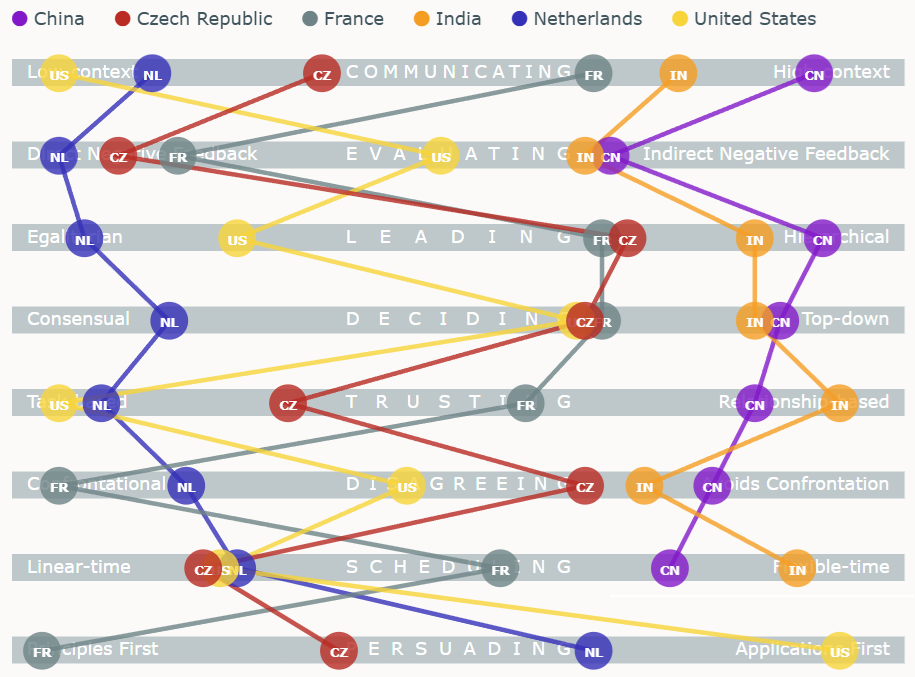
Finally, let's see the culture map of a few selected countries. You can see countries mapped in various areas. I would like to use it to explain what I think happened in my stories. I omitted the British from the map because it was too chaotic, but for our purposes, you can imagine that they are close to the United States. It wouldn't work for comparing those two countries, but comparing them to the Czech Republic or India is good enough for understanding. The following image comes from the Country Mapping Tool available here.
Stories with the culture map
The first story is on a trusting scale. The British are more task-oriented than Czechs. When the new hire told his British colleagues he is an expert, they believed him. But Czech colleagues didn't trust him because they didn't know him personally. Maybe if they spent more time knowing him, it could be different.
The observation with the word "problem" is more nuanced. It could be situated on a communicating scale as well as on a persuading scale. You can see that people from the United States communicate in low context, meaning that what they say is exactly what they mean. Furthermore, they are focusing on application first, so they are thinking of practical things. On the contrary, Czechs have higher communication context; it says that you have to be raised in our country to understand the meaning of some of our expressions. We are more principle-first oriented; that means we are thinking of the theory more than practical examples.
The next story is a good opportunity to highlight the relativity of the scales. Communication was definitely one of the challenges when writing reviews for my Indian coworkers. I claimed that Czechs have higher communication context than the United States, but in comparison with India, we have obviously lower context. In fact, their high context can lead to an inappropriate communication style when approached directly. It might have been better if I'd agreed with them to communicate directly in advance. The next issue was with the evaluating scales, where both our countries are far away. My very direct feedback, while not necessarily always negative, was probably perceived as an offense. I could try asking more rather than directly pointing out my findings. All communication could have been improved by making sure that we are on the same levels in the hierarchy or by letting our managers communicate with each other. India is more hierarchical on the leading scales than Czechia, so it would be easier for us to respect different position levels and act accordingly, which could have lead to a more effective communication.
The last story was about the French colleague disagreeing with the Czech colleague. You can see on the scales that the French are not afraid to confront others when they don't like something. Czechs usually try to avoid confrontation, so our colleague might have been surprised by the impassionated reaction of the French coworker. I guess she managed it in a good way when she asked another French colleague, who was unbiased, to try to reach out to his fellow countryman.
What can you take from this?
Communication is key; try to ask more, clarify everything, and don't expect that everyone understands things the same way as you. The country mapping tool can help as the starting point when communicating with people of different nationalities. However, be aware that each person is still unique, so respect our diversity.
If you find this topic fascinating or you would like to learn more, don't hesitate to get the discussed book. It reads well, it's full of examples, and it advises how to solve various encounters. You can also try the Country Mapping Tool, or you can take one step further and you can evaluate your own profile in the Personal Profile Tool available here.
Share article
Author
Vojtěch HrbasDeveloper, I am tinkering with many things, in my personal life I would call myself a nerd or a geek, but also a DIY guy. I like the term Renaissance man, you need to aim high.
Get the latest updates from the world of Edhouse – news, events, and current software and hardware trends.
Thank you for your interest in subscribing to our newsletter! To complete your registration you need to confirm your subscription. We have just sent you a confirmation link to the email address you provided. Please click on this link to complete your registration. If you do not find the email, please check your spam or "Promotions" folder.