Artificial intelligence has become a common part of everyday life for many people. In the workplace, we primarily use it because it helps us work faster, more efficiently, and with less effort. It can automate routine tasks, simplify information retrieval, and take over parts of both creative and analytical work. Its contribution to productivity is undeniable.
Despite increasing productivity and making everyday work easier, AI may come at a cost. Common concerns include the potential weakening of critical thinking, a reduced ability to retain information, and the gradual erosion of certain skills.
These concerns are becoming increasingly relevant as AI continues to evolve at an unprecedented pace. Not long ago, most people thought of AI as a chatbot capable of answering questions, although not always accurately. Today, AI not only generates text and code, but can also act as an autonomous agent capable of handling complex tasks with minimal human supervision. For this reason, it is worth paying attention to the potential side effects that may become more pronounced as AI capabilities continue to grow.
Cognitive Offloading
One of the mechanisms through which such side effects may arise is known as cognitive offloading. This refers to situations in which we transfer part of our mental effort to an external tool, whether it is a calculator, a navigation system, or, more recently, artificial intelligence. The concept itself is not new and can be highly beneficial in many situations, as it allows us to focus on more complex tasks instead of routine activities.
A good example is GPS navigation. In the past, people had to actively plan routes, remember landmarks, and continuously assess their direction of travel. Today, most of us simply follow navigation instructions. While this makes traveling easier and faster, some studies suggest that long-term reliance on navigation systems may weaken our ability to create our own mental maps of the surrounding environment.
A similar principle can be observed when using AI. The more tasks we delegate to artificial intelligence, the fewer opportunities we have to practice the skills needed to solve those tasks independently.
How AI Affects Skill Development
Let us now look at an interesting study published by Anthropic in early 2026 titled How AI Impacts Skill Formation. The study involved 52 software developers, the vast majority of whom had more than four years of programming experience, and all participants had at least some experience with Python. Each participant also had basic experience using AI for programming.
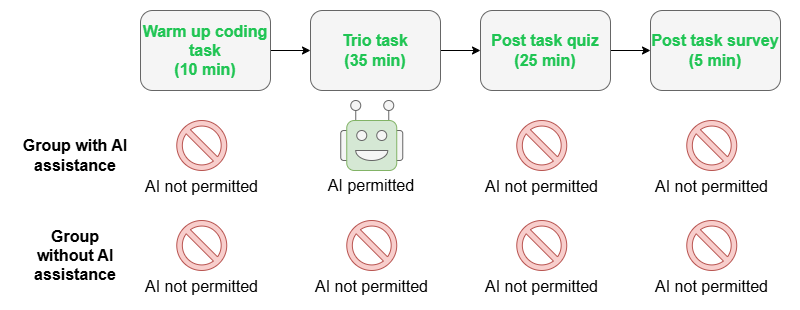
The study design is illustrated in the figure below. Participants first completed a simple programming task in Python. This introductory activity served both as a warm-up and as an opportunity to become familiar with the development environment used in the study. Participants then completed two independent programming tasks in Python using the Trio library, which none of them had previously encountered. They were provided with task descriptions, explanations of the Trio concepts required to solve the problems, and starter code.
Half of the participants were allowed to use an AI chatbot based on GPT-4o during the programming phase. They could use it for implementation assistance, explanations of generated code, explanations of Trio concepts, and, upon request, it could even produce complete solutions to both assignments. The other half had no access to AI assistance and had to rely solely on their own knowledge and skills.
After completing the programming tasks, participants took a knowledge test focused on understanding key Trio concepts, reading code, writing code, and identifying bugs. The goal was to determine how well participants from both groups had learned to work with the Trio library. The final part of the study consisted of a short survey in which participants shared their impressions of the experiment.
The researchers sought answers to two key questions:
Does the use of AI increase productivity in tasks that require learning new skills and abilities?
Does the use of AI influence the acquisition of new knowledge and skills?
Source: Adapted from Shen & Tamkin, How AI Impacts Skill Formation (Anthropic, 2026)
Study Results
The results showed that the group using the AI chatbot completed both programming tasks approximately 1 minute and 45 seconds faster on average than the group without AI. However, this difference was not statistically significant. In contrast, the non-AI group scored 17% higher on average in the follow-up quiz, a statistically significant difference.
In other words, AI provided only a marginal increase in productivity while simultaneously leading to a poorer understanding of newly learned concepts.
The researchers also analyzed how participants used AI. Based on screen recordings, they identified six usage patterns and found that outcomes depended heavily on how AI was used. The highest quiz scores (65% or higher) were achieved by participants who used AI as a learning tool and actively worked to understand the generated code.
In contrast, participants who delegated problem-solving to AI or made little effort to fully understand the generated solutions achieved considerably lower scores, with a maximum of only 39%.
How Participants Used AI
Task Completion Time (min)
Quiz Score (%)
Skill Development Potential
Generated a complete solution and then asked follow-up questions about the generated code
24
86
High
Generated parts of the solution and gradually requested explanations of the generated code
24
68
High
Asked only conceptual questions and implemented the solution independently without AI-generated code
22
65
High
Let AI generate all the code
19,5
39
Low
Started coding independently but gradually relied on AI to generate the complete solution
22
35
Low
Used AI primarily for finding and fixing bugs
31
24
Low
Key Takeaways from the Study
We often use artificial intelligence to improve productivity. This study suggests that when learning new skills, AI did not lead to a significant increase in speed. Therefore, when learning something new, we should ask ourselves whether AI is appropriate for the task and, if we decide to use it, carefully consider how to use it effectively.
The greatest benefits appear when AI is used as a learning aid that helps explain new concepts rather than as a tool that solves problems on our behalf. When learning, maximizing productivity should not be the primary goal. Instead, the focus should be on developing our own skills. Notably, the authors of the study also mention dedicated learning modes available in tools such as ChatGPT and Claude Code.
These findings are particularly relevant for junior developers. They are often under pressure to complete tasks as quickly as possible, and AI can significantly help them do so. However, if they use AI solely for mindless code generation, they may miss out on the experience that is critical for professional growth.
The ability to assess whether AI-generated code is high quality, secure, and appropriate for use does not develop automatically. It is built through writing code, reading code, debugging, and solving problems. Ironically, these are exactly the activities that overreliance on AI can gradually displace.
This study represents only one piece of a much larger puzzle. The researchers examined a relatively small group of developers learning a specific Python library. The evaluation focused primarily on participants' immediate understanding of new concepts shortly after completing the programming tasks. Therefore, the results should not be interpreted as evidence that AI inevitably weakens human abilities or knowledge over the long term.
Nevertheless, the study provides valuable insights into the potential consequences of cognitive offloading and demonstrates that the way AI is used can play a significant role in skill acquisition. The long-term impact of AI on human capabilities remains an important topic for future research.
What Should We Take Away?
The goal of this article is not to argue that using AI is inherently bad. On the contrary, AI is an exceptionally useful tool in many situations and can dramatically improve efficiency, especially when performing routine work that does not require deep thinking.
What is important, however, is recognizing that the way we use AI can influence what we learn while working. If our goal is to master a new technology, programming language, or field of expertise, it is often beneficial to use AI primarily for explaining concepts and validating our own ideas. On the other hand, if we need a quick solution to a one-off problem in an area we do not intend to study further, delegating that work to AI may be perfectly reasonable. The most important question, therefore, is not whether to use AI, but how to use it.
Tomáš MikulajA developer specializing primarily in web applications and the .NET platform. I enjoy expanding my knowledge of both backend and frontend technologies.
Get the latest updates from the world of Edhouse – news, events, and current software and hardware trends.
Thank you for your interest in subscribing to our newsletter! To complete your registration you need to confirm your subscription. We have just sent you a confirmation link to the email address you provided. Please click on this link to complete your registration. If you do not find the email, please check your spam or "Promotions" folder.