Why Quality Management Matters More Than Ever in the Age of AI
14.8.2026Jan Zatloukal
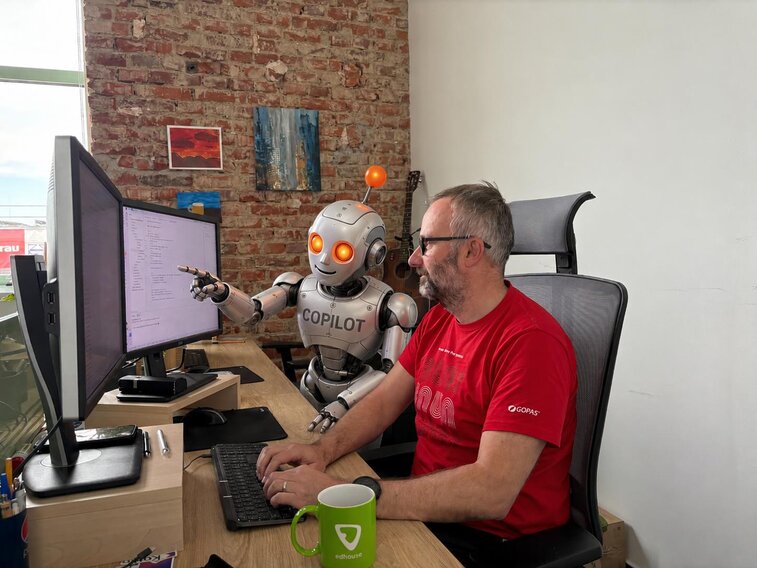
With the help of AI agents, developers are cranking out code faster than ever before. Today, you can whip up a new feature, write its tests, and generate the documentation in under a minute. While productivity is skyrocketing and development cycles are shrinking, this rapid pace comes with a brand-new set of risks.
Who’s Keeping an Eye on Quality When AI Writes the Code?
Higher efficiency doesn't automatically mean better quality. AI can easily misinterpret business logic, miss critical context, overlook security risks, or lack deep domain expertise. Just because code is bug-free doesn't mean the application actually works as intended. Test scenarios might end up covering edge cases that real users will never touch, while completely skipping vital flows that could crash your production environment.
In the era of AI-driven development, quality doesn't just happen by default — quite the opposite. Without well-defined processes and checkpoints, you run the risk of shipping a mountain of new features that simply don't work correctly.
Setting Up Processes and Checkpoints
It used to be that a human tester stood at the very end of the development line. They would test the application, try to break it in every imaginable (and unimaginable) way, and catch the majority of bugs. Combined with automated testing, this was a highly effective quality control system.
Today, things look very different — teams are smaller and the tempo is significantly faster. There's rarely time left for manual testing, making properly configured processes and automation absolutely critical.
The underlying principles of quality management haven't actually changed; what has changed is the urgent need to have everything correctly configured and to stick to the rules. This is exactly where quality gates come into play.
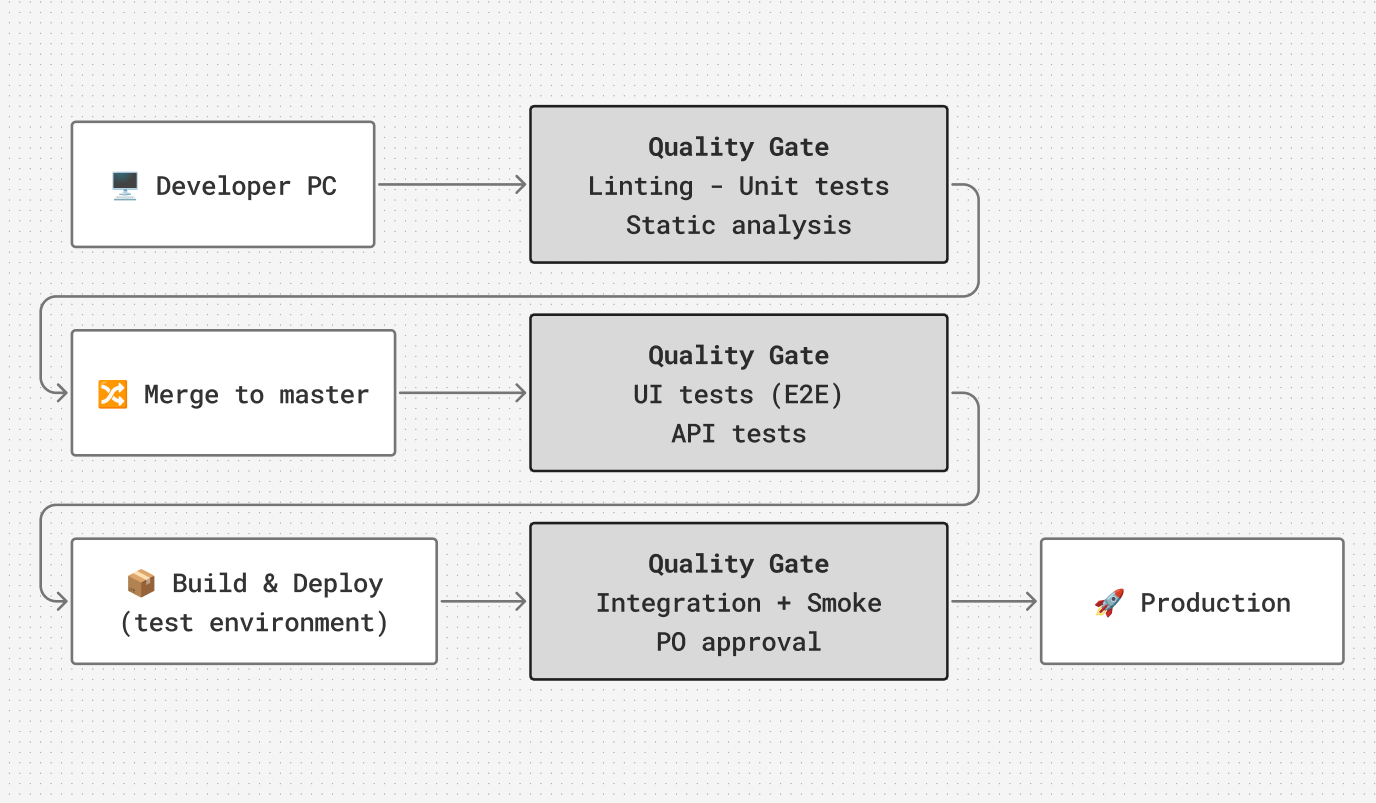
A quality gate is a checkpoint that determines whether code is ready to move to the next phase of the development cycle. It could be the pass rate of automated tests, the output of a code review, a clean security scan, or a sign-off from the product owner. The key is that this checkpoint must be clearly defined, have a distinct owner, and feature explicit pass criteria.
How to Set Up a Quality Gate
Start by mapping out your development process in a diagram, paying close attention to the transitions between individual phases. Be thorough and don't be afraid to drill down into the finest details.
For instance, before code travels from a developer’s local machine to the main repository branch, it might pass through several intermediate stages: local coding or AI generation, pushing to a feature branch, code review, and a pull request.
At each of these transitions, you should implement a specific level of verification and assign clear accountability for that check.
The sooner you catch potential issues, the faster and easier they are to fix, making the resolution much cheaper and more efficient. It is best practice to adopt a shift-left approach, moving critical checks from the tail end of the development cycle and weaving them throughout the entire process.
Quality gates shouldn't act as a bottleneck; they serve as automated guardrails that bring transparency and continuity to your quality management framework.
Who Is Responsible for Quality?
AI-assisted development brings up a big question of liability for quality. The old adage still holds true — quality is the responsibility of the entire team. However, the reality is that when everyone is responsible, usually no one is.
Ultimately, accountability should rest with the project lead — whether that’s a product owner, project manager, or another designated role. But since that person can’t micro-manage every single line of code written, developers must remain responsible for the code they submit — regardless of whether they wrote it from scratch or generated it using AI.
This is another area where quality gates shine. These checkpoints ensure that every step in the process has a clear definition and a designated person (or role) accountable for it. This allows the person ultimately responsible for the project to define these gates properly so they can confidently sign off on the final delivery.
Where Does SQA Fit In? An Unexpected Advantage
With all this automation and AI, where does that leave Software Quality Assurance (SQA) engineers?
The code itself is starting to take a back seat. AI can generate it in seconds with a single prompt. The real skill now lies in knowing what to prompt, why to build it, and how to frame it within a meaningful business context.
While SQA engineers might not possess the deep code-authoring skills of a senior developer, their broader expertise is becoming more valuable than ever. Those who understand the complete development lifecycle from planning to delivery — who grasp systemic risks, communicate effectively with both developers and stakeholders, and know how to design robust quality processes — hold a massive advantage in today’s landscape.
The Bottom Line
AI is fundamentally changing how we build software, but it doesn't change the ultimate question: Are we delivering a high-quality product?
The answer doesn't depend on how many lines of code we can generate in a day. It depends entirely on whether we have the right processes in place.
In the age of AI, it’s no longer about who writes the code. It’s about who guards the quality.
Share article
Author
Jan ZatloukalQA & Cybersecurity Technical Lead dedicated to process automation and the development of mature corporate standards. Previously focused on automating electron microscopes, I now specialize in cybersecurity and the integration of development processes.
Get the latest updates from the world of Edhouse – news, events, and current software and hardware trends.
Thank you for your interest in subscribing to our newsletter! To complete your registration you need to confirm your subscription. We have just sent you a confirmation link to the email address you provided. Please click on this link to complete your registration. If you do not find the email, please check your spam or "Promotions" folder.